

A founder closes out the quarter with strong revenue and a profit-and-loss statement that looks exactly as it should. Then payroll is due, and the bank balance says something different from the P&L implied.
This is the gap between cash flow vs. profit, and it catches growing businesses by surprise more often than founders expect. This piece breaks down what separates the two. We’ll explain why profitable companies still run into cash shortages and how proactive tax strategies and forecasting can help close that gap before it becomes a liquidity problem.

What is cash flow vs. profit?
Profit and cash flow answer different questions, and confusing them is one of the most common blind spots among scaling founders.
Profit is an accounting measure. You calculate it on the income statement by subtracting expenses from revenue over a defined period. It follows accrual accounting rules: revenue is recorded when it’s earned. A business will invoice a client, recognize that revenue immediately, and report a profitable month even though the client hasn’t paid yet.
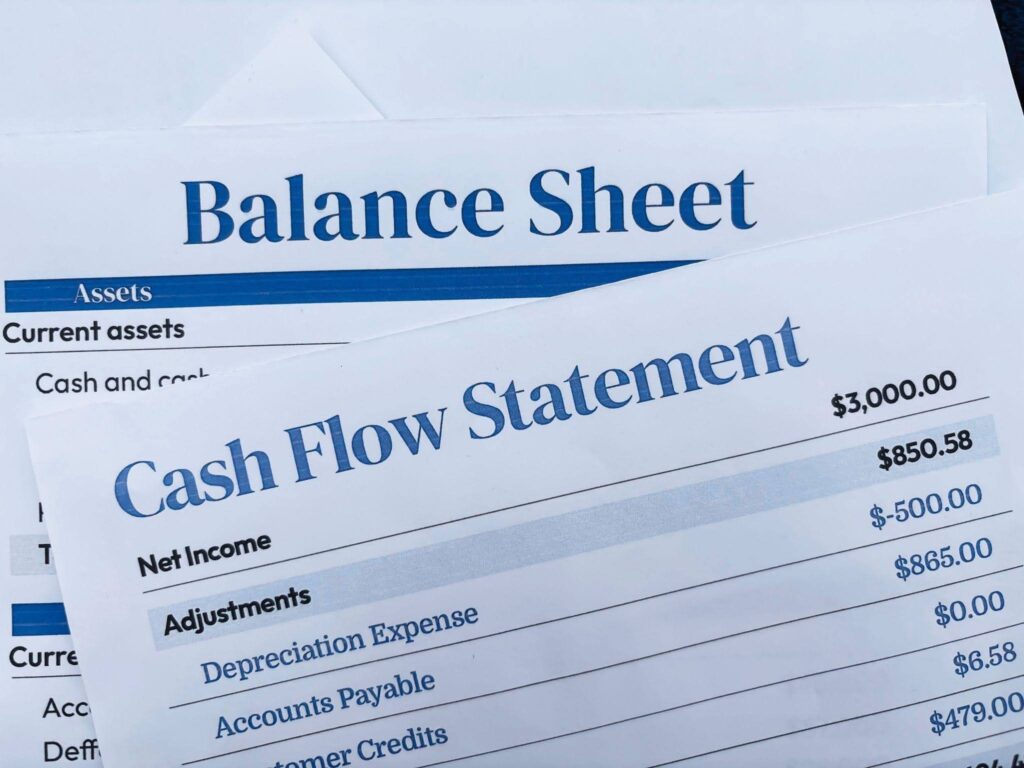
Cash flow tracks something different: the actual movement of money into and out of the business, recorded on the cash flow statement as it happens. It doesn’t care when revenue was earned or when an expense was incurred. It only reflects when cash changes hands.
This is why cash flow vs. profit shows up as a real operational problem rather than a semantic one. A business may be profitable on paper for months while cash reserves shrink, because the timing of collections and payments (as well as non-cash accounting entries) rarely lines up with the timing shown on the income statement.
Founders who track only profit are often working from a picture that’s several weeks or months out of date relative to what’s actually happening in the bank account.
Understanding this distinction is the first step toward building tax planning and cash management practices that reflect your business’s actual financial position.
Why does the gap happen
The distance between profit and cash usually stems from a handful of predictable timing mismatches that show up in nearly every growing business.
Accounts receivable
Accounts receivable is the most common driver. When a business extends net-30 or net-60 payment terms, your revenue gets recognized the moment you issue the invoice, but the cash doesn’t arrive until the client actually pays.
A company scaling revenue quickly often sees receivables grow faster than collections can keep pace, which means more of its “profit” is sitting in unpaid invoices rather than the bank.
Inventory
Inventory works similarly in the other direction. Cash goes out to purchase or produce inventory well before that inventory sells and generates revenue. A business building up stock ahead of a busy season may show reduced cash on hand for months before that spending shows up as profit.
Capital expenditures
Capital expenditures create the same effect. Buying equipment, upgrading systems, or investing in facilities requires upfront cash, but accounting rules often spread that cost over several years through depreciation. The cash leaves the business immediately; the expense trickles onto the income statement slowly.
Debt service
Debt service adds another layer. Loan principal payments reduce cash every month, but only the interest portion of those payments appears as an expense on the income statement. A business making steady loan payments can look profitable while cash is quietly leaving to cover principal that never touches the P&L.
Owner distributions and non-cash accounting entries
Owner distributions and non-cash accounting entries round out the list. Distributions pull cash out of the business without being classified as an expense, and items like depreciation and amortization reduce reported profit without any cash changing hands, working in the opposite direction of the other timing gaps.
An example scenario
Consider a services company generating strong year-over-year revenue growth, with margins that would make most advisors happy. The founder reviews the P&L each month and sees consistent profitability. Yet the business regularly finds itself scrambling to cover payroll in the days before it’s due, drawing on a line of credit simply to bridge the gap.
The disconnect isn’t a mystery once you examine the numbers closely. Larger clients have negotiated extended payment terms, so a growing share of reported revenue sits in accounts receivable rather than the bank.
At the same time, the company recently financed new equipment to support that growth, and the loan’s principal payments are quietly reducing cash every month without appearing as an expense anywhere on the income statement.
Add a seasonal build-up in inventory ahead of a busy quarter, and the business is spending cash faster than its income statement would suggest.
Why this matters for scaling founders
For businesses in the $5M–$50M range, the stakes attached to this gap are higher than they were earlier in the company’s life.
Payroll obligations grow with headcount.
Vendor commitments scale with volume.
Debt service increases as the business takes on financing to fund expansion.
At this size, a cash shortfall affects the business’s ability to meet its most basic obligations on time.
Lenders and investors compound the pressure. Both groups evaluate a business’s cash position as closely as its profitability, if not more closely. A founder walking into a financing conversation with strong profits but weak cash-flow visibility raises questions about how well the business understands its own financial mechanics, regardless of how healthy the underlying operations are.
Growth itself adds urgency. Scaling typically requires more working capital, since faster growth usually means more cash tied up. A founder who has outgrown reactive, backward-looking financial reporting needs cash flow visibility that keeps pace with the business’s speed.
This is where cash flow vs. profit stops being an accounting distinction and becomes a leadership issue. Founders who understand the difference make different decisions.
- They negotiate payment terms deliberately,
- They time capital expenditures around cash position
- They build tax planning into their broader financial strategy

Common mistakes founders make
Certain patterns recur when profitable businesses run into cash problems. Recognizing them early tends to matter more than any single fix applied after the fact.
Treating the P&L as a cash proxy: Many founders build financial processes around monthly profit reviews without a parallel process to track cash, leaving the business managing the wrong number.
Skipping cash flow forecasting: Without a forward-looking projection, cash shortfalls tend to surface as surprises rather than as risks identified weeks in advance.
Overlooking accounts receivable aging: Revenue booked but uncollected for 60 or 90 days is often treated as cash already available, even though in practice it may never convert within the original timeline.
Timing capital expenditures around opportunity rather than cash position: Equipment purchases or facility upgrades made without checking current and projected cash reserves can strain the business even when the purchase itself was sound.
Underestimating debt service obligations: Loan principal payments are easy to lose track of because they don’t appear on the income statement, which can lead a business to undercount a real monthly cash outflow.
Reacting to tax obligations instead of planning for them: Tax planning handled only at filing time misses opportunities to align payments with cash availability throughout the year.
Each of these reflects a gap in the process. Founders solve them once they build the underlying cash flow vs. profit distinction into a regular financial review.
Data and research insights regarding cash flow vs. profit
Independent research consistently shows the gap between cash flow and profit as one of the most common financial blind spots for growing businesses.
According to SCORE, cash flow is the top reason small businesses fail, contributing to 82% of closures.
A GAO investigation into small business contractor payments found that the majority of small business owners interviewed said late payments forced them to rely on lines of credit or personal resources to fund day-to-day operations. In some cases, the resulting cash flow strain raised real concerns about the ability to continue operating.
Founders regularly underestimate how early this pressure shows up.
A 2026 survey from digital banking platform Bluevine found that more than half of small business owners encounter a significant cash flow crisis within their first three years of operation, even as most owners report their overall experience running the business has met or exceeded expectations. Strong performance and a cash crisis often occur simultaneously.
Taken together, this research points to the same conclusion: cash flow vs. profit is a gap that appears early, recurs often, and rewards founders who build forecasting and tax planning into their financial operations before the shortfall arises.

How a proactive tax strategy closes the gap
Most of the timing mismatches covered so far are structural. They come from how accrual accounting works, how clients pay, and how growth ties up cash. But one lever within a founder’s control is tax planning.
Reactive tax preparation treats taxes as a once-a-year event: file and pay whatever you owe. That approach has no relationship to cash position.
Proactive tax strategies work differently. Instead of calculating a liability after the fact, they build tax obligations into the business’s ongoing cash flow planning throughout the year.
That could mean the following:
- Adjusting quarterly estimated payments to reflect actual cash position rather than prior-year assumptions
- Timing large purchases or capital expenditures around both their tax treatment and their cash impact
- Structuring entity or compensation decisions with an eye toward smoothing liability across the year instead of concentrating it.
This is also where the distinction between a bookkeeper, a tax preparer, and a fractional CFO becomes practical rather than theoretical. Effective tax planning requires visibility into cash flow forecasts.
A fractional CFO function that coordinates tax strategy with cash flow forecasting can flag when a scheduled tax payment will fall during a seasonally tight cash period and adjust either the payment timing or the business’s cash reserves accordingly.
For founders scaling past the $5M mark, this coordination tends to matter more. Tax liabilities grow with revenue. Estimated payments become larger and more consequential if mistimed.
And the cost of treating tax planning as a backward-looking compliance task, rather than a forward-looking cash management tool, compounds every year the business keeps growing without addressing it.
Proactive tax strategies won’t entirely eliminate the gap between cash flow and profit, since much of it is structural. But they remove one of the more controllable pressures on the equation, and they do it in a way that reactive tax preparation doesn’t.
FAQ
Q: What’s the simplest way to explain cash flow vs. profit to a non-finance team?
Profit measures whether the business earned more than it spent over a period. Cash flow measures whether the money from that activity has actually arrived in the bank. A business can be profitable yet cash-poor if revenue is booked before collection.
Q: How often should a growing business review its cash flow statement?
Monthly, at a minimum, alongside the income statement. Businesses with tighter margins, longer payment terms, or seasonal revenue often benefit from weekly cash flow reviews, since monthly snapshots can miss short-term timing gaps before they become payroll or vendor payment problems.
Q: Why does my business show a profit but still struggle to make payroll?
This usually points to accounts receivable outpacing collections, recent capital expenditures, or loan principal payments that reduce cash without appearing on the income statement. A cash flow forecast, rather than the P&L alone, typically identifies which of these is driving the shortfall.
Q: Can tax planning actually improve cash flow?
Yes. Proactive tax strategies adjust estimated payments and structure liabilities around a business’s actual cash position throughout the year, rather than producing a single large obligation at filing time. This reduces the chance of a tax payment landing during a seasonally tight cash period.
Q: What’s the difference between a cash flow forecast and a cash flow statement?
A cash flow statement reports what has already happened. A cash flow forecast projects what’s expected to happen over the coming weeks or months based on receivables, payables, and planned expenses. Forecasting is the tool that catches a cash shortfall before it arrives.
Q: At what revenue size should a business start taking cash flow forecasting seriously?
There’s no fixed threshold, but the need grows sharply with the following:
- Once a business scales past $5M in revenue
- When payroll, vendor commitments, and debt service all increase in size and consequence
- When a short-term cash gap can no longer be easily absorbed

Book a consultation with STRIV CPAs
Profit and cash aren’t the same metric, and treating them as interchangeable is one of the most common ways growing businesses end up reacting to shortfalls rather than anticipating them.
Cash flow vs. profit is a structural gap built into how accrual accounting works. Still, it’s also a gap that responds to better forecasting, tighter receivables management, and proactive tax strategies built around a business’s actual cash position rather than its calendar.
If your business is showing strong profit but you’re still watching the bank balance more closely than you’d like, that gap is worth a closer look before it becomes a real constraint.
STRIV’s team works with scaling founders to integrate cash flow forecasting and tax planning into a single coordinated strategy, so growth doesn’t come with cash flow surprises. Schedule a consultation call with STRIV CPAs to see where your business stands and what closing that gap could look like.