

Most founders evaluate fractional CFO services for the first time without a clear standard for what a strong engagement looks like. The market gives them little help. Providers range from solo consultants to established advisory firms, and scopes range from a few advisory hours to hands-on financial leadership, making it hard to compare proposals.
The best solution to the financial and tax pain that comes with a scaling business is an integrated three-service approach: fractional CFO, proactive tax strategy, and tax compliance.
The stakes are real. The right hire brings financial clarity, sharper forecasting, and tax planning that keeps pace with growth. In contrast, a poor fit can cost months of momentum and tens of thousands in fees before the problem becomes obvious. The difference often comes down to the questions you ask before signing.
This guide covers the questions that separate strategic finance partners from expensive task managers, the answers that should give you confidence, and the evaluation mistakes that catch even experienced founders. Use it as a working checklist for your next candidate conversation.

What does a fractional CFO do?
A fractional CFO provides senior financial leadership on a part-time or contract basis, typically serving multiple companies simultaneously. The role covers the strategic work a full-time CFO would own: cash flow forecasting, budgeting, financial modeling, KPI reporting, fundraising preparation, and board-level financial communication.
Founders often engage fractional CFO services when the business has outgrown what a bookkeeper, controller, or CPA firm can provide but does not yet justify a full-time executive salary.
The distinction between roles matters more than many founders expect.
- Bookkeepers record transactions.
- Controllers manage accounting operations and ensure accurate reporting.
- A fractional CFO interprets that financial data and turns it into forward-looking decisions about pricing, hiring, capital, and growth.
More often than not, a scaling business needs support at all three levels.
When the role is well scoped, tax planning sits within that strategic picture rather than outside it, since decisions about entity structure, compensation, and the timing of major purchases carry tax consequences that compound as revenue scales.
Engagements typically range from a few hours a month for advisory oversight to several days a month for hands-on financial leadership. The right structure depends on your revenue stage, the complexity of your operations, and the strength of the finance team already in place. That variability is exactly why the questions below matter.
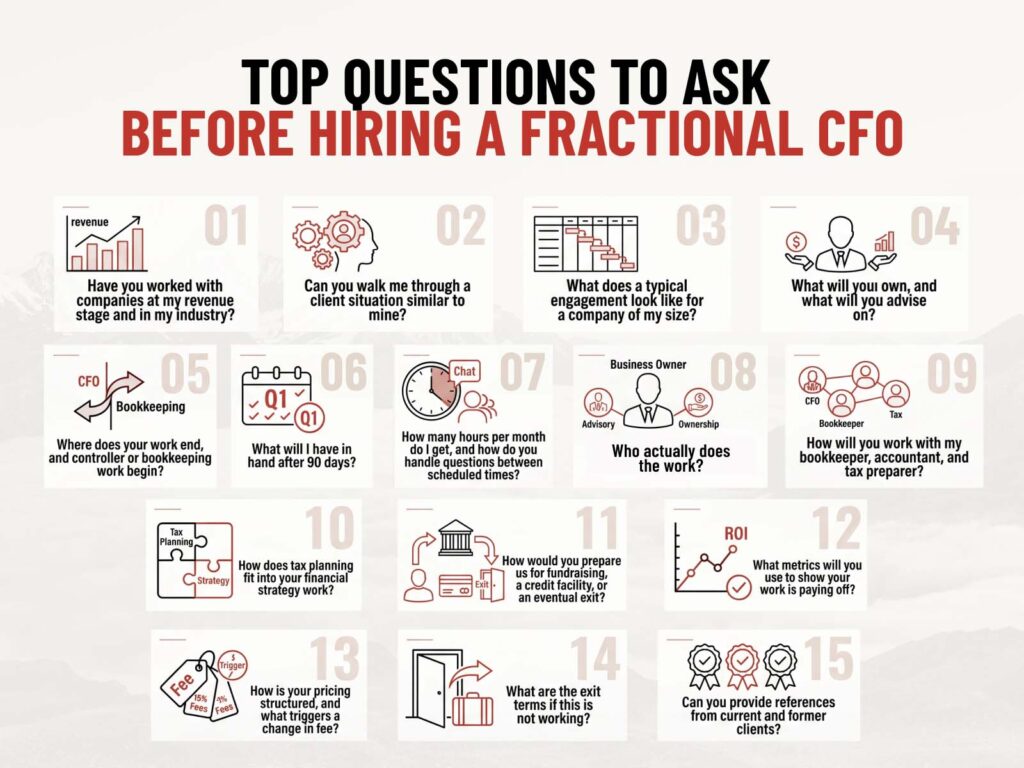
Top questions to ask before hiring a fractional CFO
The questions below are grouped into five areas. You don’t need to ask every candidate every question, but covering each area at least once gives you a complete picture.
Fit and experience
1. Have you worked with companies at my revenue stage and in my industry?
A CFO who has guided SaaS companies from $3 million to $20 million brings a different pattern recognition than one who has spent a career in manufacturing. Neither background is better in the abstract, but relevance to your situation shortens the learning curve you are paying for.
2. Can you walk me through a client situation similar to mine?
Strong candidates answer with specifics: the problem they found, the approach they took, and the outcome. Vague answers here often predict vague deliverables later.
3. What does a typical engagement look like for a company of my size?
This question reveals whether the candidate has a repeatable methodology or improvises with each client. Both can work, but you should know which one you are buying.
Scope and deliverables
4. What will you own, and what will you advise on?
Some fractional CFOs build the forecast themselves. Others review what your team builds. The difference shapes costs, speed, and the amount of your own time the engagement requires. Ask for the dividing line in writing.
5. Where does your work end, and controller or bookkeeping work begin?
Founders sometimes need accounting cleanup more than they need strategy, and paying CFO rates for reconciliations is an expensive way to discover that. A candid candidate will tell you when the work you are describing belongs to a different role.
6. What will I have in hand after 90 days?
Concrete early deliverables signal a structured practice. A rolling cash flow forecast, budget-versus-actuals reporting, and a KPI dashboard are common examples. If the candidate can’t name specific outputs, treat that as information.
Working model
7. How many hours per month do I get, and how do you handle questions between scheduled times?
Fractional means shared attention. Knowing the response model up front prevents frustration when an urgent question lands on a day the CFO is with another client.
8. Who actually does the work?
Some firms present a senior partner during the sales process and staff the engagement with junior team members. Delegation isn’t inherently a problem, but you should know who prepares your numbers and who reviews them before you sign.
9. How will you work with my bookkeeper, accountant, and tax preparer?
Poor coordination among financial providers is one of the most common failure points in these engagements. Ask how the candidate structures communication, who owns which handoffs, and how they resolve disagreements about the numbers.
Strategy and tax planning
10. How does tax planning fit into your financial strategy work?
Many fractional CFOs treat tax as a separate discipline that belongs entirely to the CPA. That separation leaves money on the table, because decisions about entity structure, owner compensation, equipment purchases, and multi-state expansion carry tax consequences that a forward-looking finance leader should surface before year-end rather than after.
If you’re asking what does a fractional CFO do at the strategic level, integrated tax thinking is a reasonable part of the answer.
11. How would you prepare us for fundraising, a credit facility, or an eventual exit?
Even if none of these events sit on your near-term horizon, the answer shows whether the candidate thinks beyond monthly reporting. Investor-ready financials take time to build, and the groundwork starts well before a term sheet appears.
12. What metrics will you use to show your work is paying off?
A finance leader should welcome measurement. Forecast accuracy, days of cash visibility, close speed, and margin clarity are all reasonable yardsticks. Candidates who resist defining success criteria are asking you to evaluate them on effort rather than outcomes.
Commercial terms
13. How is your pricing structured, and what triggers a change in fee?
Retainers, hourly billing, and tiered packages all appear in this market. None is wrong, but you should understand how the fee changes as your needs grow, and whether scope changes require a new agreement or lead to surprise invoices.
14. What are the exit terms if this isn’t working?
A firm confident in its retention rarely needs a twelve-month minimum. Month-to-month terms or a short initial commitment suggest the provider expects to earn the renewal. Long lock-ins with steep cancellation penalties deserve scrutiny.
15. Can you provide references from current and former clients?
Former clients matter as much as current ones. Ask references what surprised them, what they would negotiate differently, and whether the engagement delivered what the sales conversation promised.
How to weigh the answers
No candidate will answer all fifteen questions perfectly, and a polished answer isn’t the same as a true one. Look for specificity, willingness to define boundaries, and curiosity about your business.
The best fractional CFO services function as thought partners who ask you hard questions in return. If you leave the conversation having done all the talking, the candidate learned a great deal about you, but you learned very little about them.
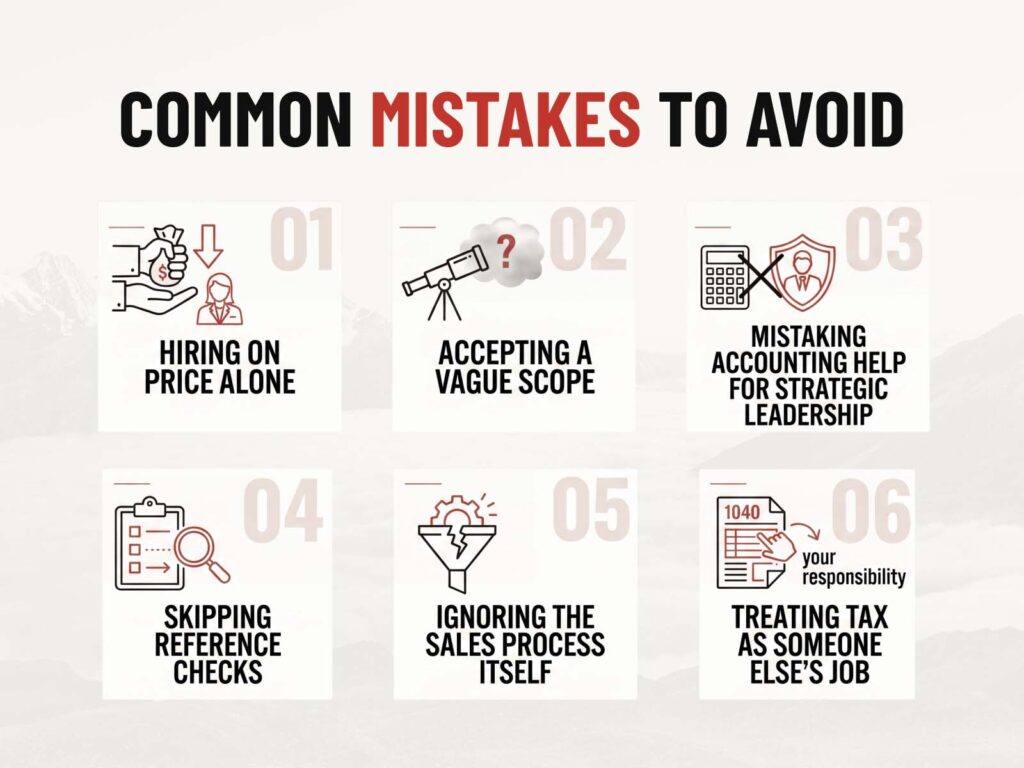
Common mistakes to avoid when evaluating candidates
Even careful founders can miss these during the evaluation process:
Hiring on price alone: The least expensive proposal often reflects the narrowest scope. Compare candidates on deliverables and fit first, then weigh cost against what each engagement actually includes.
Accepting a vague scope: An engagement that starts with “we will figure out what you need as we go” usually ends with the founder managing the CFO, rather than the other way around. Get ownership boundaries in writing.
Mistaking accounting help for strategic leadership: If the conversation keeps drifting toward closing the books or cleaning up the chart of accounts, you may be evaluating a controller at CFO rates. Both roles have value, but they solve different problems.
Skipping reference checks: A 30-minute call with a former client reveals more than any proposal document. Ask what they would negotiate differently.
Ignoring the sales process itself: Candidates are on their best behavior before signing the contract. Slow responses or evasive answers during evaluation rarely improve afterward.
Treating tax as someone else’s job: Candidates who show no point of view on tax planning are signaling a narrower engagement than most scaling founders need.
What the research says about finance leadership
The market context helps explain why founders increasingly turn to fractional arrangements:
- The Bureau of Labor Statistics projects employment of financial managers to grow 15% from 2024 to 2034, much faster than the average for all occupations, which keeps demand for senior finance talent high and full-time hires competitive.
- CFOs at companies with revenue under $100 million most commonly report base salaries between $250,000 and $299,000, according to JM Search’s 2025 survey of sitting CFOs, before bonuses or equity enter the picture.
- Crist Kolder Associates reports that average CFO tenure has declined to 4.7 years, a reminder that even full-time hires carry turnover risk. Strong evaluation practices matter regardless of the employment model.
What to prepare before evaluating candidates
You will get sharper answers if candidates can react to real information. Before your first conversation, gather:
- Your most recent financial statements, even if you suspect they need cleanup
- A one-page summary of your revenue model, growth plans, and current finance team
- The two or three financial questions that keep you up at night
- Your current tax preparer’s contact information and a note on how tax planning is handled today
- A rough budget range for the engagement
Candidates who take these materials seriously during the sales process preview how they will engage with your business afterward.
FAQ
Q: What does a fractional CFO do?
A fractional CFO provides part-time strategic financial leadership, including cash flow forecasting, budgeting, financial modeling, KPI reporting, and fundraising preparation. The role focuses on forward-looking decisions rather than transaction recording, which remains the domain of bookkeepers and controllers.
Q: How much do fractional CFO services cost?
Pricing varies widely by scope, ranging from a few thousand dollars monthly for advisory oversight to significantly more for hands-on engagement. Compare proposals on deliverables rather than price alone, and confirm what triggers fee changes before signing.
Q: How many hours per month do I need?
Most engagements range from a few hours monthly for oversight to several days for active financial leadership. The right level depends on your revenue stage, operational complexity, and the strength of your existing finance team.
Q: When should a founder hire a fractional CFO?
Common triggers include passing several million in revenue, preparing to raise capital, expanding into multiple states, or realizing that financial questions have outgrown what a bookkeeper can answer. The need typically arrives before the budget justifies a full-time executive.
Book a Free strategy call with STRIV CPAs
The right fractional CFO engagement starts with the right questions. Press candidates on experience, scope, working model, strategy, and terms, and weigh the specificity of their answers as heavily as the content.
A candidate who defines boundaries clearly, names deliverables without hesitation, and asks hard questions about your business in return is showing you what the working relationship will look like. Founders who evaluate rigorously tend to land the best partners.
If you’re comparing fractional CFO services and want a perspective that treats tax strategy as part of financial strategy rather than an afterthought, STRIV works with scaling founders every day.
Our team helps founders build the forecasting, reporting, and tax positioning that their next stage of growth requires. Schedule a Free consultation with STRIV CPAs to discuss where your finance function stands, what it needs next, and whether a fractional engagement is the right structure to get there.