

Are you confident you aren’t overpaying in taxes?
For many founders, the honest answer is no. Their CPA shows up in March, files the return, and reports what already happened. By then, the best moves are gone.
Year-end tax planning changes that. November and December are your last chance to shape your 2026 tax bill, and this year’s rules give founders more room than usual.
This guide covers tax planning for business owners in plain terms. You’ll get a 10-move year-end tax planning checklist, year-end tax planning strategies by entity type, the mistakes that cost founders money, and how a proactive partner keeps planning going all year.
Why year-end tax planning matters for scaling founders
Once your business passes $5 million in revenue and $1 million in profit, taxes become one of your largest expenses. Small timing decisions start to carry real dollar amounts, and smart tax planning for business owners at this level turns those decisions into savings.
Most of the levers that control your tax bill lock on Dec. 31. That includes equipment placed in service, payroll-based retirement contributions, owner salary, and charitable gifts. After that date, your CPA only reports the results.
That’s the gap between filing and planning, where filing records the past, while year-end tax planning strategies shape the outcome while you still have choices.
The 2026 rules raise the stakes. With 100% bonus depreciation now permanent, the timing of a large purchase may shift a meaningful deduction into this year or the next.
Founders without a CFO feel this most. No one owns the year-end calendar, so the deadlines pass quietly. A proactive partner puts those decisions in front of you in November, not April.
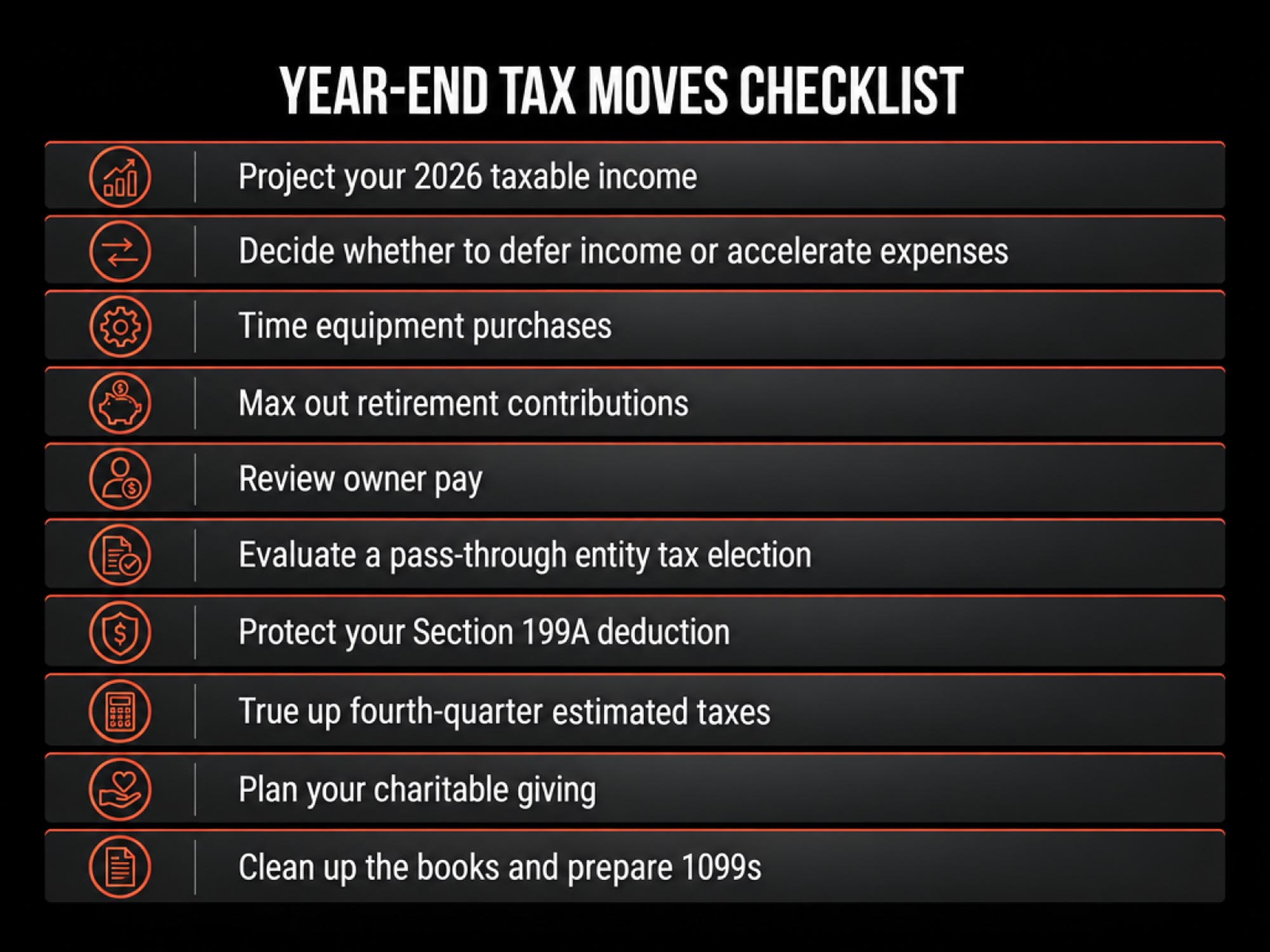
Your year-end tax planning checklist
- Project your 2026 taxable income. Start with your year-to-date profit and loss statement and forecast through December.
- Decide whether to defer income or accelerate expenses. Compare this year’s expected tax rate with next year’s.
- Time equipment purchases. Review Section 179 and 100% bonus depreciation before you buy.
- Max out retirement contributions. Consider a 401(k), SEP, or cash balance plan. Employee deferrals to a 401(k) must be processed through payroll by Dec. 31.
- Review owner pay. S-corp owners need a reasonable salary. A salary that’s too low invites IRS scrutiny, while one that’s too high means extra payroll tax.
- Evaluate a pass-through entity tax election. Many states let partnerships and S-corps pay state income tax at the entity level, which can create a federal deduction. Deadlines vary by state.
- Protect your Section 199A deduction. Wage and income limits may shrink the qualified business income deduction, so check your numbers before year-end.
- True up fourth-quarter estimated taxes. The final 2026 payment is due Jan. 15, 2027.
- Plan your charitable giving. Gifts must be made by Dec. 31 to count this year. Donating appreciated stock or bunching gifts stretches the benefit.
- Clean up the books and prepare 1099s. Collect missing W-9 forms now. Form 1099-NEC is normally due Jan. 31, which moves to Feb. 1, 2027, because Jan. 31 falls on a Sunday.
Should you defer income to next year?
It makes sense to defer income to next year when you expect a lower tax rate in 2027. Cash-basis businesses can sometimes delay invoicing or collections into January.
Accelerating expenses works the same way in reverse. Prepaying certain costs or buying supplies now can push small-business tax deductions into 2027. If you expect a big jump in profit next year, the opposite may be smarter. Run the projection before you decide to defer income to next year.
Timing equipment purchases under the 2026 rules
According to IRS Publication 946, an asset must be placed in service by Dec. 31 to count toward 2026. Buying it is not enough. It has to be installed and ready to use.
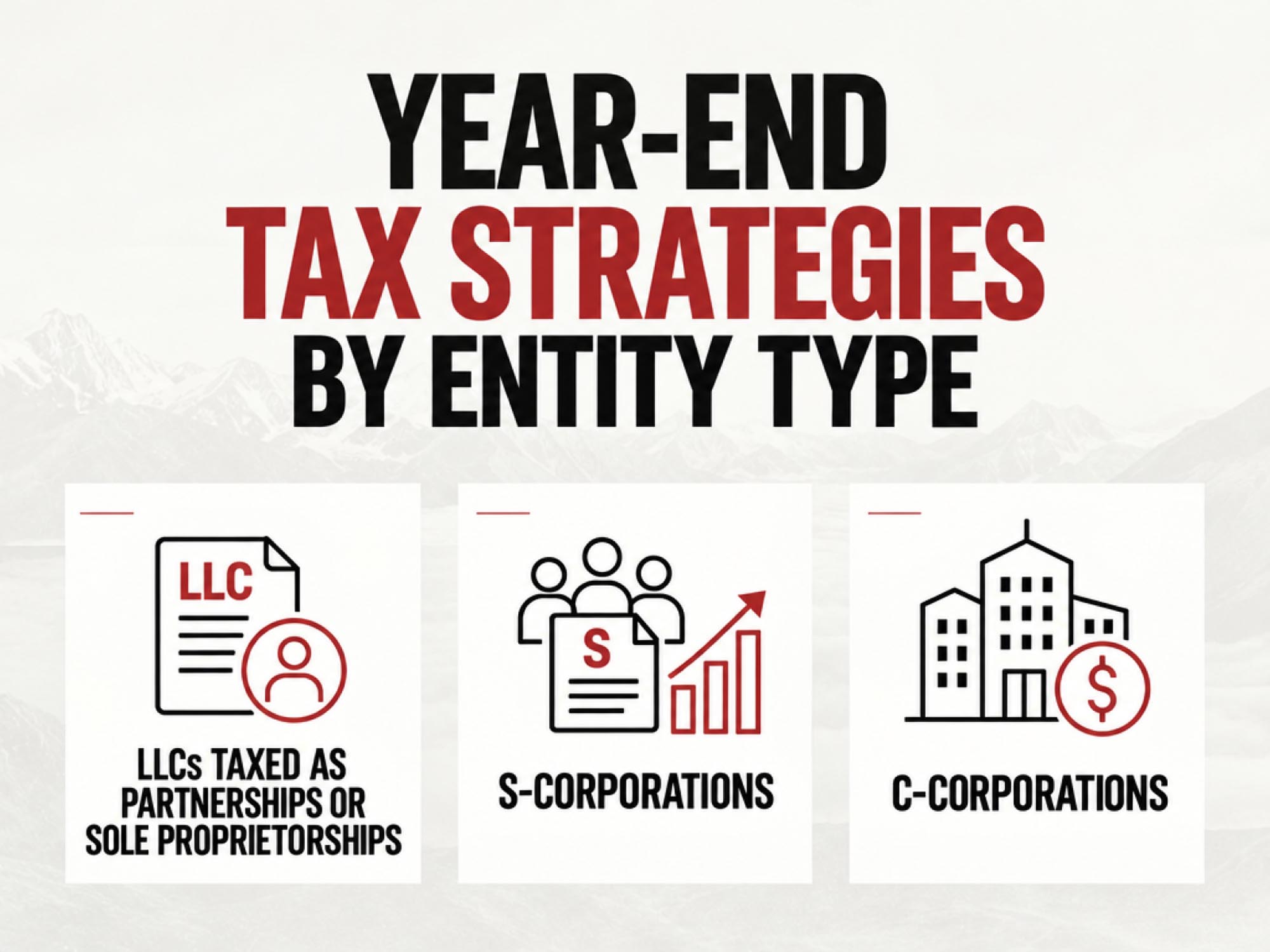
Year-end tax strategies by entity type
Your entity type changes which year-end tax strategies matter most. Here is how the checklist shifts for each structure.
LLCs taxed as partnerships or sole proprietorships
Profit flows to your personal return and is generally subject to self-employment tax. At your income level, ask whether an S corp election would lower your total tax. Review PTET eligibility in your state.
What is a PTET election?
A pass-through entity tax (PTET) election allows a partnership or S-corporation to pay state income tax at the business level rather than passing it through to the owners. Because the business deducts that payment, owners may sidestep the federal cap on state and local tax (SALT) deductions.
Each state that offers PTET sets its own election deadlines and payment rules, so confirm yours before Dec. 31. For many founders, it is one of the most valuable tax planning strategies on the list.
S corporations
Owner salary is the big lever. Set a reasonable salary, then take the rest as distributions. Pair that with a PTET review and a Section 199A check, since W-2 wages affect the deduction.
C corporations
The corporate rate is a flat 21%, which is now permanent. Planning often centers on the timing of bonuses, retained earnings, and how you withdraw funds. Accrual-basis companies may be able to deduct some year-end bonuses paid early in the new year, so confirm the rules first.
How proactive tax planning pays off in 2027
Year-end tax strategies help, but the real value comes from planning that never stops. That is where an outsourced finance department changes the game.
- No surprises in April. Quarterly projections mean you know your tax bill before it arrives.
- Better decisions all year. Hiring, equipment, and pricing choices get a tax view before you commit.
- Cleaner reporting. Monthly books give you clear, trustworthy numbers.
- One partner, not four. Bookkeeping, tax compliance, payroll, and tax strategy sit with one team.
- Lower cost than hiring. STRIV provides a full finance team at roughly one-fifth of the cost of building one in-house.
- Room to scale. Your tax planning strategies grow with your team and revenue.
STRIV’s team brings more than 25 years of experience with entrepreneurial clients. We are built by entrepreneurs, for entrepreneurs. Explore our outsourced accounting and tax services to see how the partnership works.
Common year-end mistakes founders make
- Buying equipment for the deduction. Small business tax deductions save only part of what you spend. Focus on buying what the business needs.
- Missing the placed-in-service rule. An asset sitting in a box on Dec. 31 doesn’t count.
- Ignoring state conformity. Some states don’t follow federal depreciation rules, so your state deduction may differ.
- Waiting on 1099 data. Chasing vendor W-9 forms in late January creates errors and penalties.
- Setting owner pay by habit. Last year’s salary may not fit this year’s profit.
- Skipping the projection. Without a forecast, every move is a guess.
2026 tax numbers founders should know
These figures shape most year-end tax strategies this season:
- Bonus depreciation: 100%, now permanent. Qualifying equipment placed in service by Dec. 31 may be deducted in full this year, according to Wipfli.
- Corporate tax rate: 21%, now permanent. C corporation owners now have a stable rate to plan around, as Key Private Bank notes.
- Fourth-quarter estimated tax payment: Jan. 15, 2027. This is the final installment for 2026, per the IRS.
- Form 1099-NEC deadline: Feb. 1, 2027. The usual Jan. 31 deadline falls on a Sunday this year, so it moves to the next business day.
Knowing these dates and rates keeps your small business tax deductions on schedule and helps you defer income to next year only when the numbers support it.
Tools and resources for year-end planning
- Year-to-date profit and loss statement. This is the foundation for every move on the checklist and for the small business tax deductions you claim.
- Cash flow forecast. It shows whether you can afford a purchase or prepayment before year-end.
- IRS Publication 946. This is the official guide to depreciation and Section 179.
- IRS estimated taxes page. Use it for payment deadlines and safe harbor basics.
- Your retirement plan provider. Confirm contribution limits and setup deadlines for your plan type.
- A proactive finance partner. See the strategic guidance STRIV clients rely on.
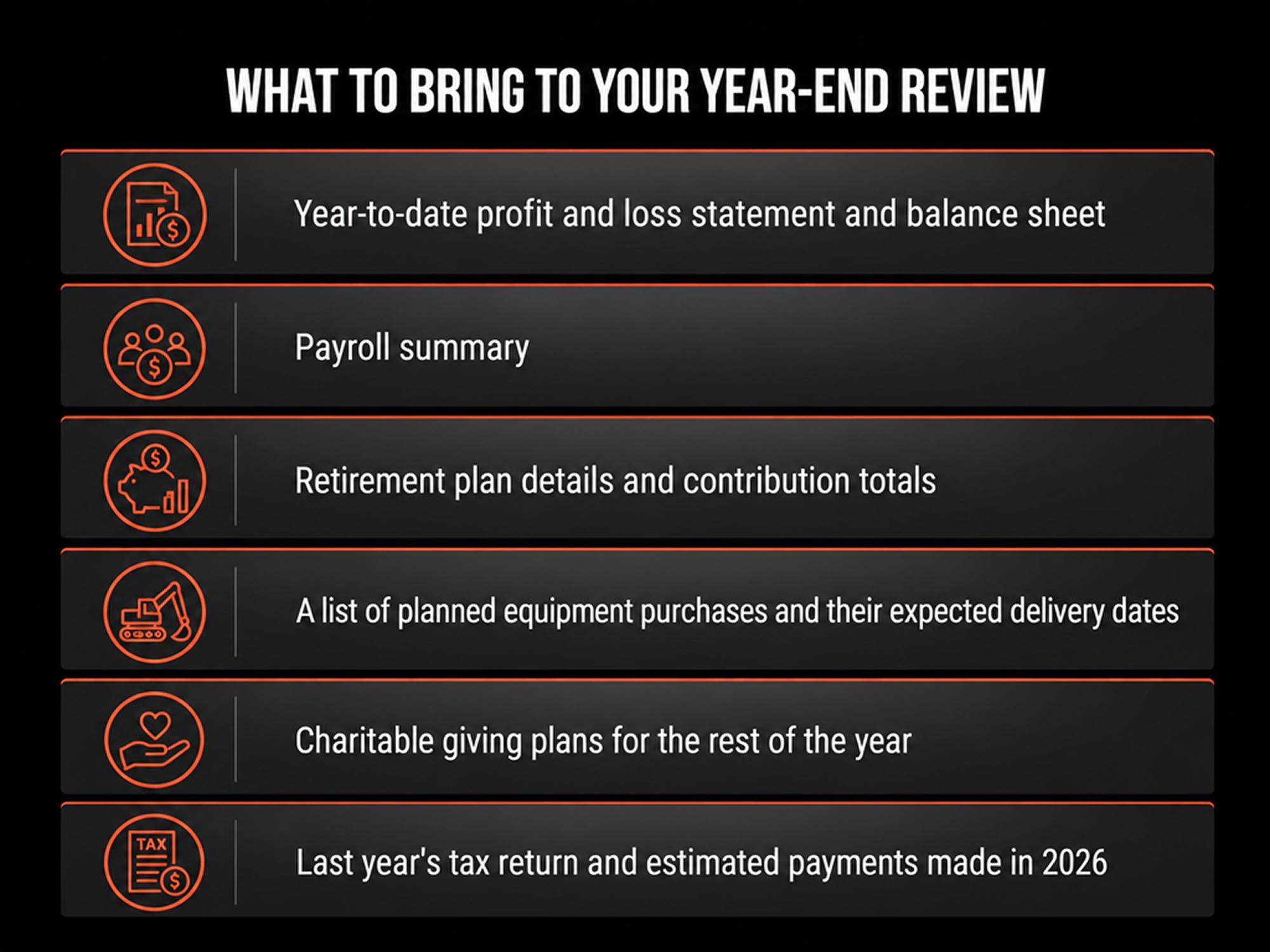
What to bring to your year-end tax review
A year-end tax planning checklist works best when your numbers are ready. Gather these before you meet with your CPA:
- Year-to-date profit and loss statement and balance sheet
- Payroll summary, including owner salary and bonuses paid so far
- Retirement plan details and contribution totals
- A list of planned equipment purchases and their expected delivery dates
- Charitable giving plans for the rest of the year
- Last year’s tax return and the estimated payments you’ve made in 2026
With these in hand, your review becomes a clear plan rather than a scramble in April.
FAQ
What is year-end tax planning, and when should business owners start it?
Year-end tax planning is a review of income, expenses, entity structure, and owner pay before Dec. 31. Start in October or early November. That leaves time to project income, set up retirement plans, place equipment in service, and adjust payroll before the year closes.
Should I defer income or accelerate expenses before Dec. 31?
It depends on your expected tax rate. If 2027 looks lower, choosing to defer income to next year and accelerate expenses usually helps. If you expect a big jump in profit next year, the reverse may save more. A projection of both years should drive the decision.
Does buying equipment before year-end lower my taxes?
It can, if the asset is placed in service by Dec. 31 and the business truly needs it. With 100% bonus depreciation permanent, much of the cost may be deductible this year. Never buy equipment only for the deduction, since you still spend the cash.
What is the difference between Section 179 and bonus depreciation?
Both let you deduct equipment costs faster. Section 179 has an annual dollar limit and is generally capped by business income. Bonus depreciation has no such income limit and applies at 100% under current rules. Your CPA can help you choose or combine them.
How do fourth-quarter estimated taxes fit into year-end planning?
Your final estimated payment for 2026 is due Jan. 15, 2027. Once your year-end moves are set, recalculate your expected tax and adjust your payment accordingly. That helps you avoid underpayment penalties without sending the IRS more than you owe.
Is it too late to lower my 2026 taxes in December?
No. Many year-end tax planning strategies still work in December, including equipment purchases, charitable gifts, expense timing, and payroll-based retirement contributions. Some steps need setup time, so act early in the month. After Dec. 31, most options close for the year.
Plan your year-end moves with STRIV CPAs
Year-end tax planning gives founders one last chance to shape their 2026 tax bill. The best tax planning for business owners comes from a partner who plans with you all year, not one who only files your return. Contact STRIV CPAs to book a year-end review and scale with financial confidence.