

When it comes to tax compliance, growth rarely announces when it has crossed a state line. A remote hire in another state, a steady stream of out-of-state customers, or inventory stored in a third-party warehouse can each create tax obligations that many founders don’t discover until a notice arrives.
In this guide, you’ll learn how multi-state tax compliance works, what typically triggers obligations in a new state, and how to build the multi-state bookkeeping and tax compliance practices that keep filings accurate as you scale.
Whether you manage compliance internally or work with a CPA for entrepreneurs, understanding these fundamentals may help you avoid penalties and make tax planning decisions with fewer surprises.
What is multi-state tax compliance?
Multi-state tax compliance is the process of identifying, registering for, and meeting the tax obligations your business has in every state where it operates. For a business with a single location and local customers, compliance typically means a single set of state filings.
As a business grows by hiring remotely, selling online, or serving clients across state lines, its footprint often expands into states where it has never filed. Each state will have its own registration requirements, tax types, filing schedules, and definitions of taxable activity.
Compliance in this context typically spans several tax categories.
- Sales and use tax may apply when you sell taxable goods or services to customers in a state.
- State income or franchise tax may apply when your business earns revenue connected to a state, with each state applying its own formula for how much of your income it is able to tax.
- Payroll taxes generally follow your employees, meaning a team member working from another state may create withholding and unemployment insurance obligations there.
- A few states also impose gross receipts taxes, which are calculated on revenue rather than profit.
What makes multi-state compliance demanding is the recordkeeping. Meeting obligations in several states requires knowing your revenue by state, where your employees physically work, and where your inventory or equipment sits. Basic bookkeeping often doesn’t capture these details.
Multi-state bookkeeping addresses this by tracking activity at the state level, so that when a filing obligation arises, the numbers behind it are already organized and defensible.
Businesses often establish tax obligations in a new state well before anyone inside the company notices. Reviewing your state-by-state activity at least annually, ideally as part of broader tax planning, tends to surface these obligations earlier and at lower cost than waiting for a state to identify you first.
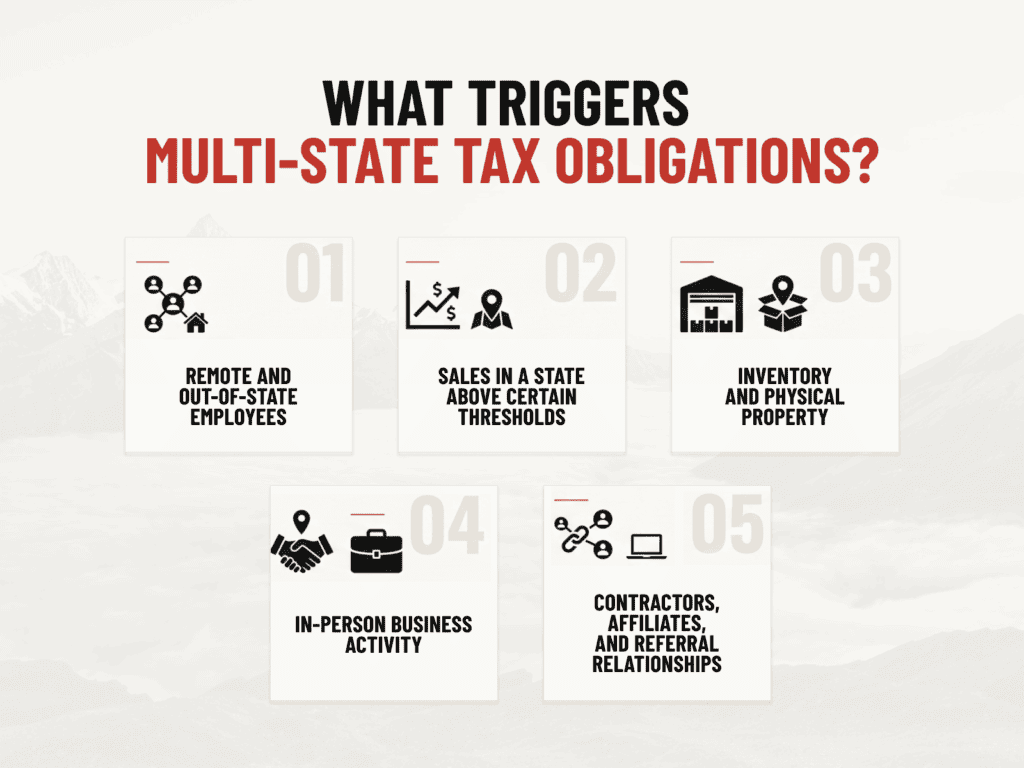
What triggers multi-state tax obligations?
As we mentioned earlier, a business generally owes taxes in a state when its activity there creates a sufficient connection under that state’s rules. The specific rules vary by state and by tax type, but most obligations trace back to a handful of common triggers. Reviewing these against your own operations is often the fastest way to understand where your business may already have filing requirements.
Remote and out-of-state employees
An employee working from another state, even if it’s a single remote hire working from home, typically creates payroll obligations in that state. This includes income tax withholding and unemployment insurance registration.
In many states, an employee’s presence also affects the business’s income and sales tax obligations, regardless of whether the employee interacts with customers.
Sales in a state above certain thresholds
Most states now require out-of-state sellers to collect and remit sales tax once their sales into the state exceed a defined threshold, commonly measured by annual revenue.
This applies even when the business has no physical presence there, which is why e-commerce and SaaS companies frequently have obligations in states they’ve never set foot in. Because thresholds and measurement periods differ from state to state, tracking revenue by state is the only reliable way to know where you stand.
Inventory and physical property
Inventory stored in a state, including inventory held in a third-party fulfillment center or warehouse, is generally treated as a physical presence in that state. Owned or leased equipment, offices, and other property in a state typically have the same effect.
In-person business activity
Temporary presence matters more than many founders expect. Employees traveling to a state for installations, training, repairs, consulting engagements, or trade shows may create obligations in that state, even when the visits are brief.
Contractors, affiliates, and referral relationships
In certain states, obligations may arise through relationships rather than direct presence. Think of independent contractors performing services on your behalf or in-state partners who refer customers to you for a commission.
Because these triggers depend on operational details rather than intent, obligations often accumulate quietly as a business grows. A founder who hires two remote employees, moves inventory into a fulfillment network, and grows online revenue in the same year may have created obligations in several states at once.
This is where multi-state bookkeeping earns its keep: books that already separate revenue, payroll, and property by state make it possible to evaluate each trigger with real numbers.
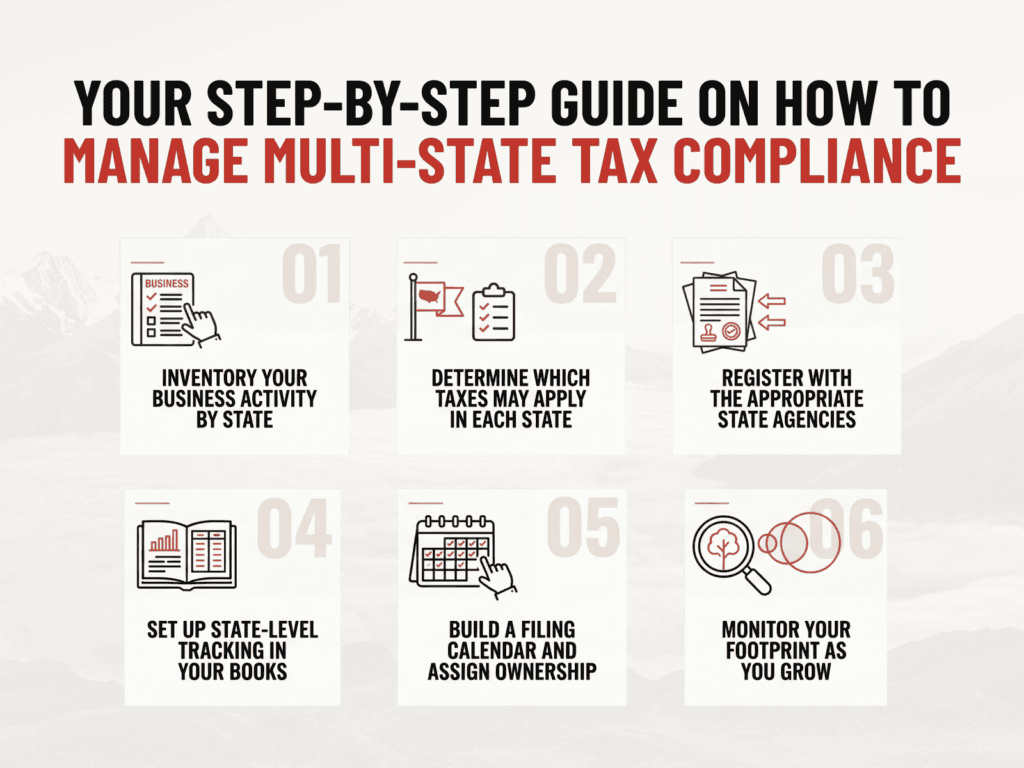
Your step-by-step guide on how to manage multi-state tax compliance
1. Inventory your business activity by state
Start by documenting where your business actually operates. List every state where you have employees or contractors, customers, inventory, or equipment, and any recurring in-person activity such as service visits or trade shows.
Pull revenue by state from your sales platforms and accounting system for at least the past 12 months. This inventory becomes the foundation for every decision that follows.
2. Determine which taxes may apply in each state
Compare your activity in each state against that state’s rules for sales tax, income or franchise tax, payroll taxes, and, where relevant, gross receipts taxes. Each tax type has its own triggers so that a business may owe payroll taxes in one state, sales taxes in another, and both in a third.
Many businesses work with a CPA for entrepreneurs at this stage, since the analysis involves judgment calls that are difficult to make confidently from state websites alone.
3. Register with the appropriate state agencies
Once you’ve identified where obligations exist, register before you begin collecting or filing. Depending on the state and tax type, this may involve the Department of Revenue, the workforce or unemployment agency, and the Secretary of State.
Registering promptly matters. Collecting sales tax without a permit or filing late after an obligation has already begun can incur penalties that registration alone would have avoided.
4. Set up state-level tracking in your books
Structure your accounting system so that revenue, payroll, and inventory can be reported by state without manual reconstruction. This is the core of multi-state bookkeeping: sales tagged by customer location, payroll mapped to each employee’s work state, and inventory tracked by warehouse location.
Getting this structure in place early means each new filing draws on existing records, rather than triggering a scramble through invoices and payroll reports.
5. Build a filing calendar and assign ownership
States differ on filing frequency and due dates. Sales tax alone may be due monthly in one state and quarterly or annually in another, often based on your volume.
Consolidate every registration renewal, filing deadline, and estimated payment date into a single calendar, and make one person or firm responsible for it. Missed deadlines are among the most common and most avoidable sources of penalties.
6. Monitor your footprint as you grow
Compliance is not a one-time project, because the activity that drives it keeps changing. A new remote hire, a new fulfillment center, or a strong sales year can each create obligations in a state where you previously had none.
Reviewing your state-by-state activity on a regular, set schedule keeps compliance aligned with reality and gives your tax planning time to respond before deadlines.
Why multi-state compliance matters
Staying ahead of multi-state obligations protects current cash flow and the company’s long-term value. Let’s take a look at how.
- It limits penalties and interest before they compound. Unpaid state taxes accrue interest and penalties from the date the obligation began, not the date a state discovers it.
- It reduces audit exposure. States continue to invest in data analytics and information sharing to identify out-of-state businesses with unmet obligations. Organized, state-level records make any inquiry that does arrive far easier to answer.
- It protects transactions and fundraising. Unresolved state tax exposure is a common finding in due diligence. Buyers and investors may reduce their offer, demand escrows, or walk away when compliance gaps surface late in a deal.
- It keeps financial statements reliable. Uncollected sales tax and unrecorded state liabilities distort margins and understate the business’s liabilities. Accurate multi-state bookkeeping ensures the financial leadership reflects true obligations.
- It strengthens tax planning. Knowing where your business files are and where it’s approaching new obligations allows decisions like where to hire, where to hold inventory, and how to structure entities to be made with the tax consequences in view, rather than discovered afterward.
- It protects the owners personally. For certain tax types, particularly sales tax collected from customers, states may hold owners or officers personally responsible for unremitted amounts.
Common mistakes to avoid
Most multi-state compliance problems trace back to a handful of recurring missteps. These are the ones we see most often in growing businesses.
Assuming physical presence is the only trigger
Many founders still operate on the older rule that obligations require an office or storefront in a state.
Overlooking payroll obligations for remote hires
Hiring an out-of-state employee is much more common post-2020 and often triggers withholding and unemployment registration requirements in that employee’s state, starting with the first paycheck.
Waiting until a state makes contact
A notice or questionnaire from a state regarding your taxes usually means the state already has information suggesting an obligation exists. They are following up, and, unfortunately, catching up on back taxes usually comes with penalties and interest.
Tracking sales only at the company level
Books that show total revenue but not revenue by state can’t answer the question that every threshold analysis depends on. Without state-level detail, businesses tend to discover obligations late, and reconstructing prior-year sales by state after the fact is slow and error-prone.
Treating every state the same
Filing frequencies, due dates, definitions of taxable products and services, and threshold rules all differ by state. Applying one state’s assumptions across your whole footprint often leads to missed deadlines or under-collected tax.
Resolving discovered exposure without guidance
When a business discovers unfiled obligations from prior years, simply registering them can prompt a state to look back. Many states offer voluntary disclosure programs that may limit how far back liabilities reach and reduce penalties, but the sequencing matters.
A CPA for entrepreneurs who has handled these situations can typically evaluate whether a voluntary disclosure agreement makes sense before filing any registration.
Data and statistics regarding multi-state compliance
- All 45 states with a statewide sales tax, plus the District of Columbia, have adopted economic-presence-based requirements for out-of-state sellers rather than physical-presence requirements.
- The GAO estimates that nationwide remote sales tax collections reached roughly $30 billion in 2021, reflecting the growing number of states pursuing this revenue.
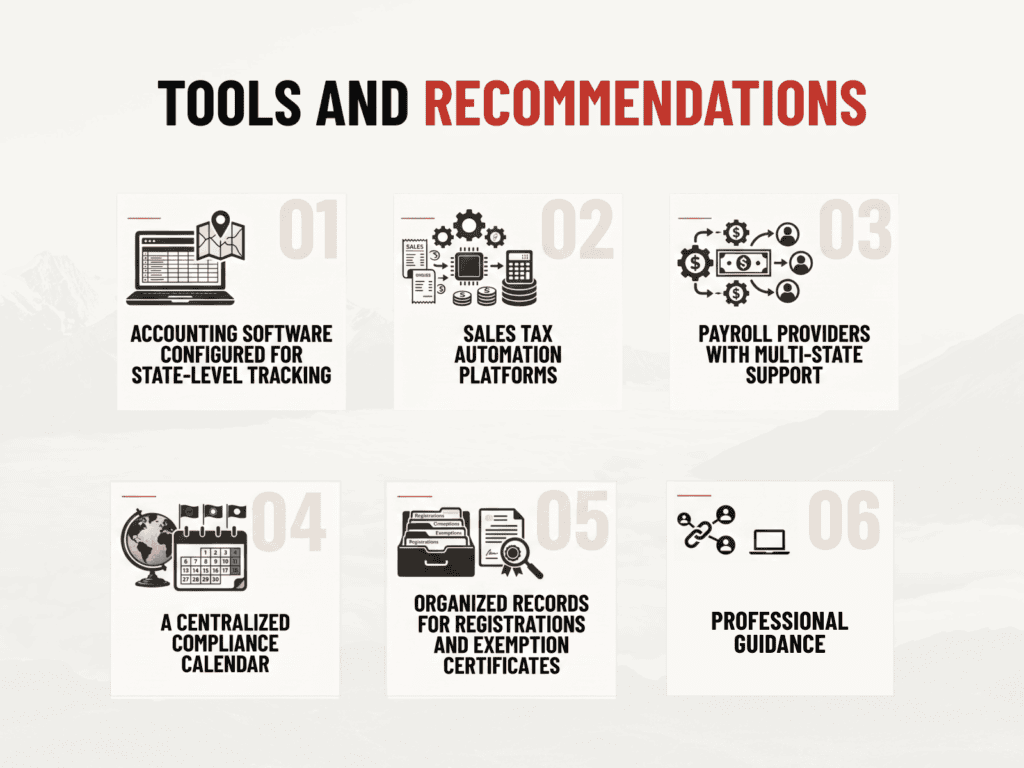
Tools and recommendations
- Accounting software configured for state-level tracking
- Sales tax automation platforms
- Payroll providers with multi-state support
- A centralized compliance calendar
- Organized records for registrations and exemption certificates
- Professional guidance
FAQ
Do remote employees create state tax obligations?
Generally, yes. An employee working from another state typically requires income tax withholding and unemployment insurance registration there, starting with their first paycheck. In many states, an employee’s presence can also create income or sales tax obligations for the business itself.
What happens if my business should have been filing in a state but wasn’t?
Liabilities generally accrue from the date the obligation began, including interest and penalties. Many states offer voluntary disclosure programs that may limit the reach of liabilities and reduce penalties. It’s often wise to consult a professional before registering.
Do I need to collect sales tax in every state where I sell?
Not necessarily. Sales tax collection is typically required only in states where you have a physical presence or where your sales exceed that state’s threshold. Whether your specific products or services are taxable also varies by state, so the analysis is state-by-state.
How do states find out about non-compliant businesses?
States use data analytics, information sharing between agencies, payroll and marketplace records, and audits of related businesses. Many also send questionnaires to companies they suspect have obligations. Receiving one usually means the state already has information suggesting a connection exists.
When should a business get professional help with multi-state compliance?
Ideally, before expanding, when planning a remote hire, entering new markets, or moving inventory across state lines. A CPA for entrepreneurs can assess your footprint, address any past exposure, and set up systems that keep compliance current as the business grows.
Contact STRIV CPAs today
Multi-state tax obligations tend to arrive quietly, and the businesses that handle them well are usually the ones that saw them coming. Solid multi-state bookkeeping gives you the state-level records compliance on which proactive tax planning depends, and proactive tax planning turns those records into decisions.
If your footprint has grown beyond one state, STRIV’s advisors can help you assess where you stand. Schedule a consultation to get started.