

Scaling companies often buy equipment and software faster than their tax planning keeps pace, and the timing of the deductions on those purchases can move a large share of an asset’s cost into a single tax year. The One Big Beautiful Bill Act made 100% bonus depreciation permanent and raised the Section 179 limits, which gives founders more room to plan and more decisions to make.
This guide explains how these three deductions fit together, how to choose between them, and which mistakes to avoid heading into 2027. Founders who combine these rules with strategic tax consulting can match each purchase to the deduction that best serves the business.
What depreciation, bonus depreciation, and Section 179 are
Depreciation is the standard method for recovering the cost of a long-lived business asset. A company deducts the price gradually over the recovery period specified by the tax code for that asset class, commonly five or seven years for equipment and furniture, rather than deducting it all in the year of purchase.
Bonus depreciation accelerates that schedule. Under the One Big Beautiful Bill Act, qualifying property acquired after January 19, 2025, qualifies for a permanent 100% first-year deduction.
IRS Notice 2026-11 confirms that companies can generally continue to rely on existing regulations while new ones are drafted. The deduction applies automatically unless a company elects out for a property class.
Section 179 reaches a similar result through an election. The same law raised the Section 179 dollar limits, and a company can choose which qualifying purchases to expense, up to a cap that never exceeds its taxable business income.
Companies that coordinate both rules through proactive tax strategies control how much of each purchase lands in the current year.
How to choose between them
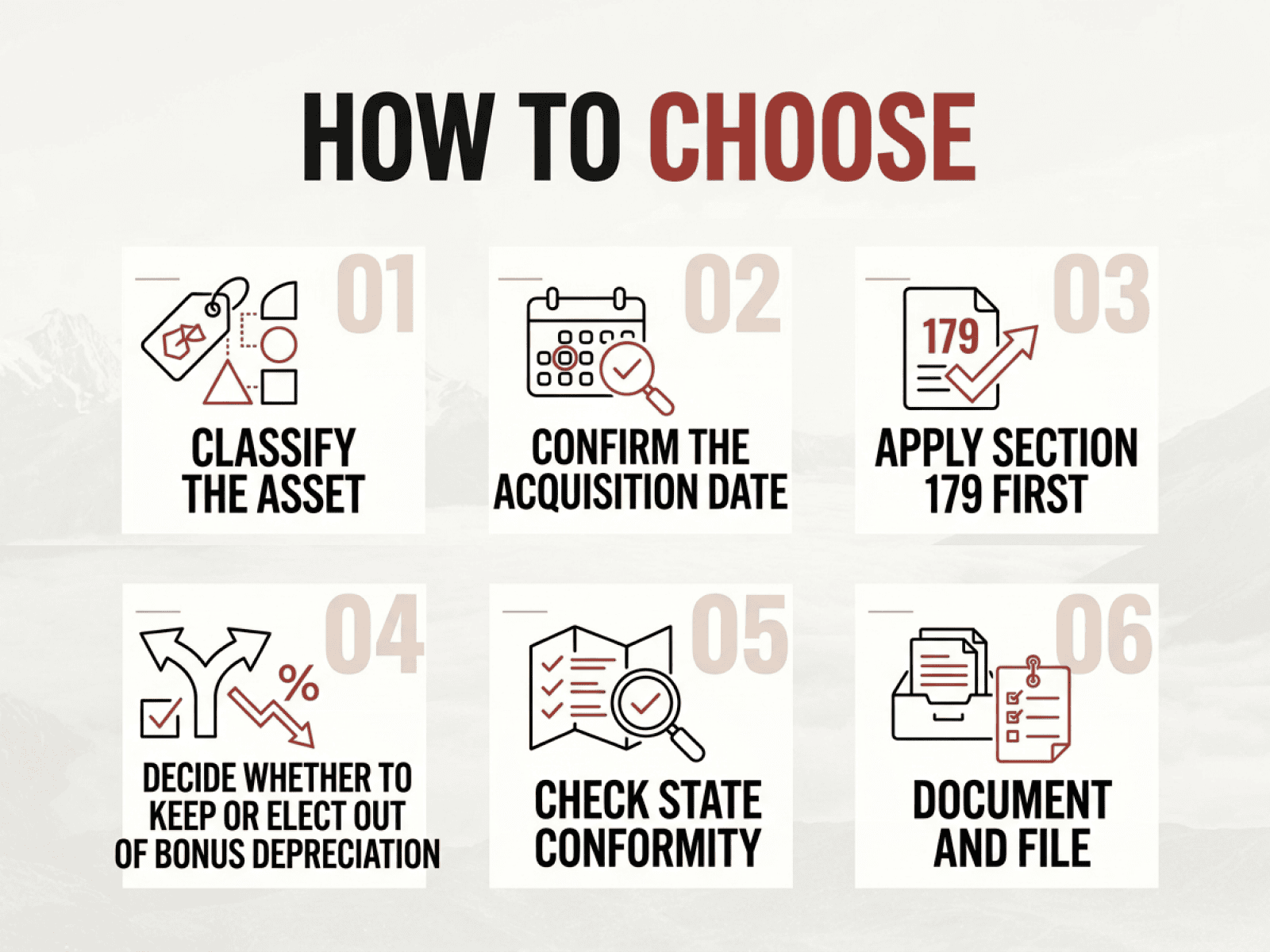
Work through these decisions in order so that each purchase receives the correct tax treatment.
- Classify the asset. Identify its recovery period under the tax code. Bonus depreciation applies to property with a recovery period of 20 years or less, which covers most equipment and software.
- Confirm the acquisition date. The permanent 100% rate applies to property acquired after January 19, 2025, so a binding contract signed before that date could change the result.
- Apply Section 179 first. Decide which purchases to expense under Section 179, within the annual cap, and your taxable business income. Section 179 comes before bonus depreciation in the calculation.
- Decide whether to keep or elect out of bonus depreciation. The election covers an entire property class, so weigh it against expected income. A company with low current income may prefer to defer deductions.
- Check state conformity. Confirm whether your state follows the federal rules, because states that decouple may require separate depreciation schedules.
- Document and file. Record elections on Form 4562 and keep the asset register current. Accurate records keep tax preparation for entrepreneurs with fast-growing asset lists on schedule.
A strategic tax consulting review will cover these steps before year-end, even if purchase timing may still change.
Why this matters going into 2027
Several practical shifts shape planning for 2027.
- Permanence removes the year-end rush. Because 100% bonus depreciation no longer phases down, companies can make one-time purchases to meet operational needs rather than a shrinking deduction.
- Section 179 limits adjust annually. The dollar cap and phase-out threshold are indexed for inflation, so each year’s figures need a fresh check.
- State rules still diverge. States that decouple from federal bonus depreciation can change which method produces the better combined result.
- Losses become a planning variable. Bonus depreciation may result in a net operating loss, making projected income central to each purchase decision.
Companies that build proactive tax strategies around these shifts can plan purchases months in advance rather than reacting in December.
Common mistakes to avoid
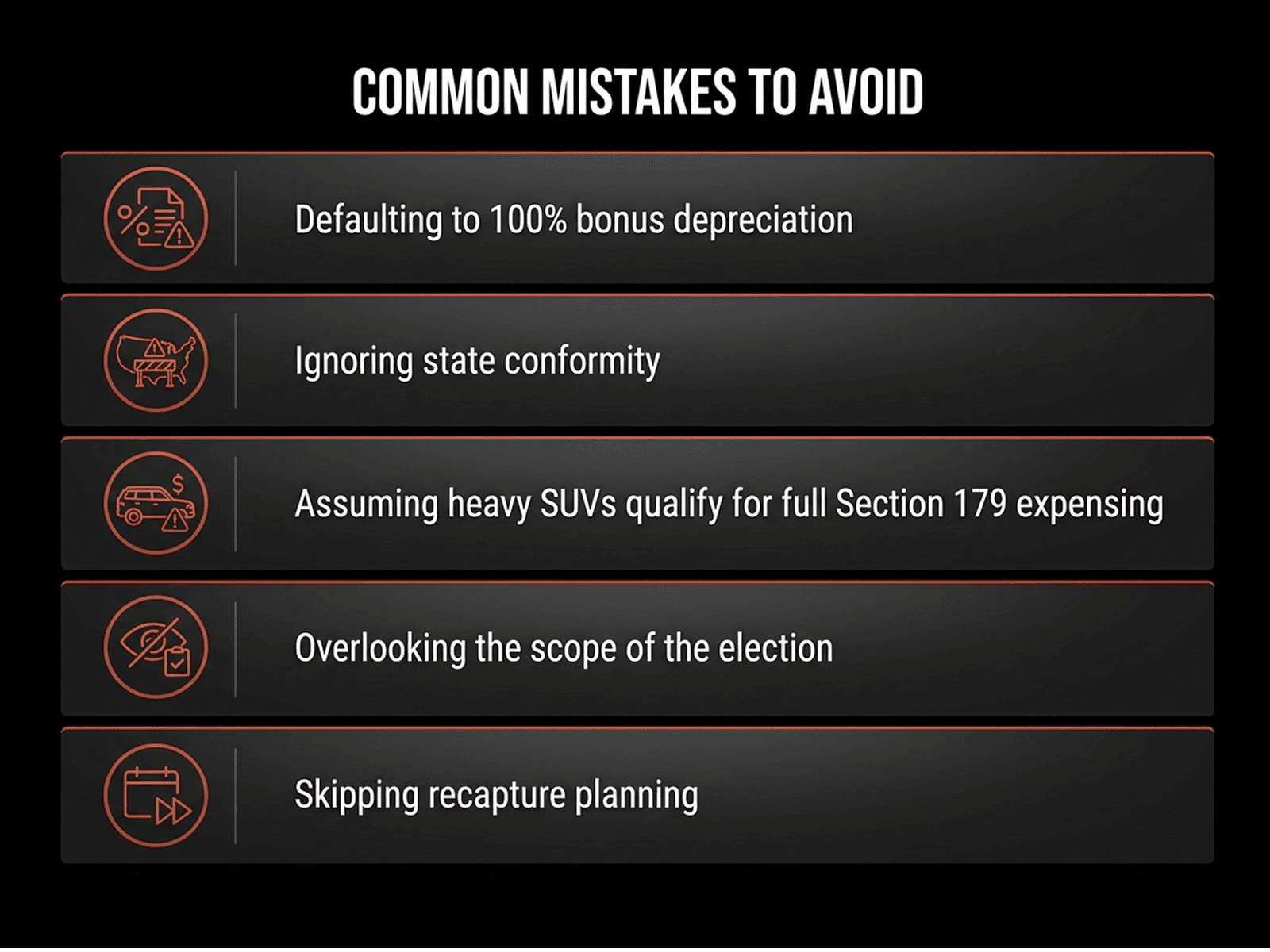
Most errors stem from applying a default rather than evaluating each purchase.
- Defaulting to 100% bonus depreciation. Taking the full deduction without projecting future income could leave deductions unused in a year when they would have been worth more later.
- Ignoring state conformity. A federal deduction that a state disallows creates a separate state calculation and a second set of depreciation schedules.
- Assuming heavy SUVs qualify for full Section 179 expense. The deduction carries a cap, and bonus depreciation covers the remainder.
- Overlooking the scope of the election. Opting out of bonus depreciation applies to every asset in a property class.
- Skipping recapture planning. Selling an asset for more than its remaining tax basis may trigger recapture of prior deductions as ordinary income.
A review during tax preparation for entrepreneurs should catch each of these before the return is filed.
Key numbers to look at each year
The IRS has not yet published the 2027 Section 179 figures, so the 2026 amounts from Revenue Procedure 2025-32 illustrate how the limits work.
| Item | 2026 amount |
| Maximum Section 179 deduction | $2,560,000 |
| Phase-out begins at | $4,090,000 of qualifying purchases |
| Fully phased out at | $6,650,000 of qualifying purchases |
| Section 179 cap for heavy SUVs (6,001 to 14,000 pounds GVWR) | $32,000 |
| Bonus depreciation rate | 100% for property acquired after January 19, 2025 |
The 100% bonus rate is permanent and carries into 2027. The 2027 Section 179 amounts will appear on the IRS guidance page once the agency publishes its revenue procedure. Proactive tax strategies treat the 2026 figures as a baseline.
Tools and resources
- Fixed asset register. Records each asset’s cost and placed-in-service date.
- IRS Form 4562 and Publication 946. The form reports depreciation and elections, and the publication explains recovery periods.
- Depreciation software. Produces federal and state schedules side by side.
- Purchase calendar. Lists planned purchases and expected in-service dates for advance modeling.
Strategic tax consulting combines these tools with projected income to test each purchase before it’s placed in service.
FAQ
What is the difference between bonus depreciation and Section 179?
Section 179 is an elective deduction limited by a dollar cap and taxable business income. Bonus depreciation has no dollar cap, applies to property classes unless a company elects out, and may result in a net operating loss.
Is 100% bonus depreciation permanent?
Yes. The One Big Beautiful Bill Act made 100% bonus depreciation permanent for qualifying property acquired after January 19, 2025. Congress can still change tax law, so proactive tax strategies include reviewing the rules each year.
Can a company use Section 179 and bonus depreciation on the same purchase?
Yes. Companies generally apply Section 179 first, up to its limit, and then claim bonus depreciation on the remaining cost. Heavy SUVs follow this pattern, with Section 179 capped and bonus depreciation covering the rest.
When should a growing company plan its depreciation elections?
Plan before you start using what you purchase, because the deduction depends on that date. A review of tax preparation for entrepreneurs, ideally before year-end, leaves time to adjust purchase timing.
Work with STRIV CPAs
When implemented correctly, these proactive tax strategies will help you as your company scales. STRIV CPAs is here to help you make the most of depreciation, bonus depreciation, and Section 179. Whether you have questions about anything in this blog or are ready to scale and want help with the process, STRIV CPAs is ready. Schedule a consultation with us today to get started.