

Founders usually sign a fractional CFO contract expecting immediate answers, while questions usually come first. That gap between expectation and reality is where most engagements either build trust or lose it.
If you’re bringing on fractional CFO services for the first time, it helps to know what a well-run engagement actually looks like week to week. This piece walks through the diagnosis, stabilization, and strategy phases that make up a typical 90-day arc, what the advisor is doing behind the scenes, and where founders tend to get impatient before the value shows up.
Keep reading to learn more.
What this kind of engagement actually does during onboarding
A fractional CFO isn’t a bookkeeper with a bigger title, and the first 90 days make that distinction clear. Bookkeeping records what has already happened. This person builds the systems that show what’s about to happen and gives a founder room to act on it before a problem becomes urgent.
During onboarding, the work typically spans four areas at once.
-
- Financial infrastructure: ensuring the chart of accounts, the reporting structure, and the underlying data are sufficiently accurate to support decision-making.
- Cash visibility: a rolling forecast that replaces guesswork about upcoming shortfalls.
- Reporting discipline: a repeatable monthly close and a small set of KPIs that actually predict trouble for that specific business.
- Strategic finance: includes tax planning, pricing decisions, and capital allocation once the basics are stable.
That sequencing matters. An advisor who jumps straight to strategy or tax decisions before the numbers are trustworthy is building on sand. Founders who get the most value from the arrangement tend to be those who understand that the opening weeks are deliberately unglamorous, and that the unglamorous work is what makes everything that follows reliable.
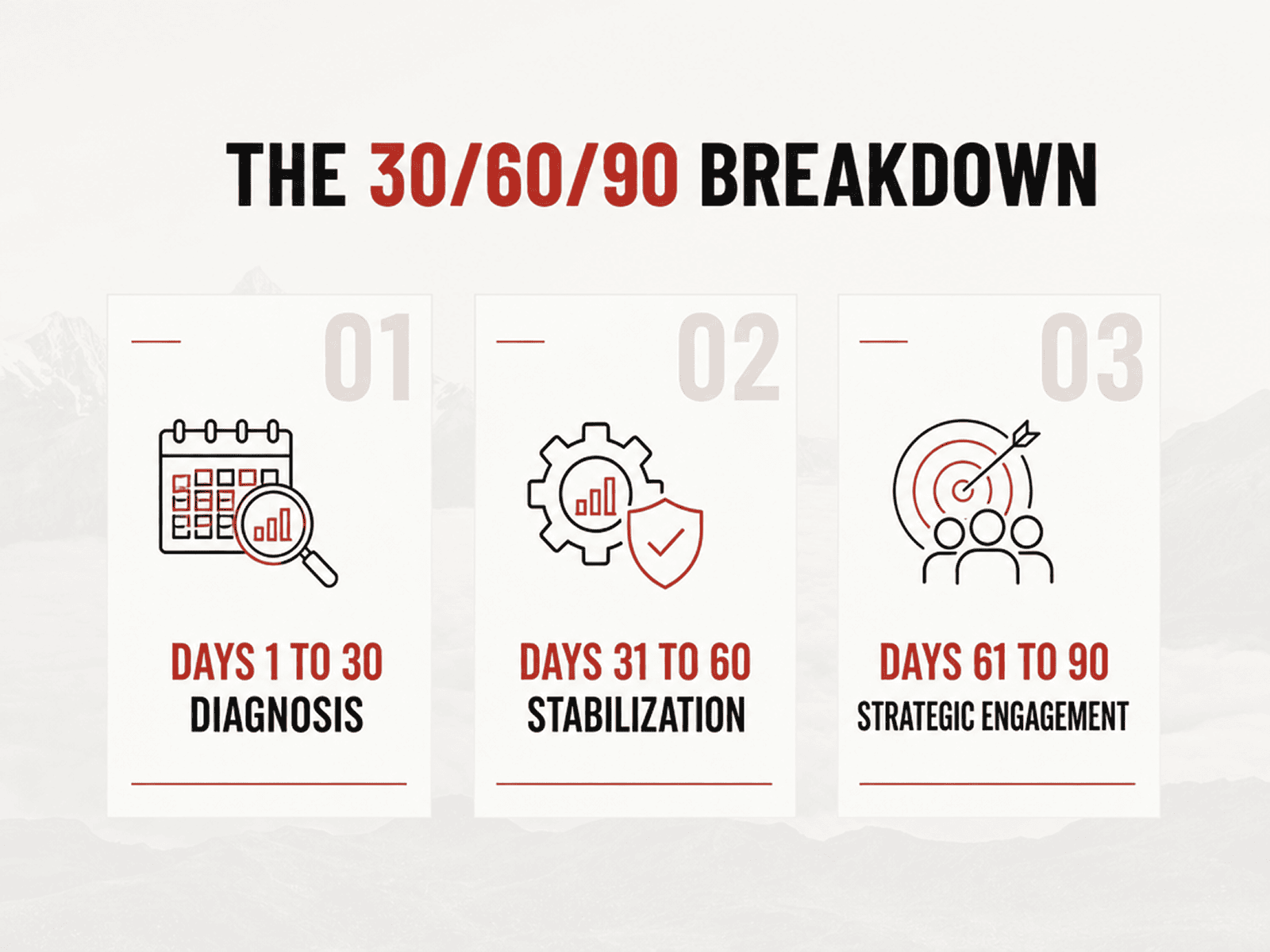
The 30/60/90 Breakdown
Days 1 to 30: Diagnosis
The opening month is an audit. During this phase, the CFO will typically:
- Reconcile the chart of accounts and clean up categorization errors that have been quietly distorting the P&L
- Review AR and AP aging to understand how cash actually moves through the business
- Assess current tax planning practices, including entity structure, estimated payments, and whether prior filings still match how the business operates today
- Map decision-making authority: who approves spending, who has visibility into cash, and where that visibility breaks down between departments
- Interview department heads or team leads to understand where financial data gets lost or delayed before it reaches leadership
Most engagements end the first month with a diagnostic summary. This is the document that tells a founder, often for the first time in plain language, where the business stands and what needs attention first.
It’s common for this summary to surface at least one issue the founder didn’t know existed: an underpriced service line or a client concentration risk hiding in the revenue mix. This reflects the reality that most growing businesses outgrow their financial visibility long before they notice it.
Days 31 to 60: Stabilization
With a clean baseline in place, month two is about building repeatable systems. This typically includes standing up a 12-month rolling cash forecast, establishing a fixed monthly close calendar, and identifying the handful of KPIs that matter most for that business model.
For a services firm, that might mean utilization and realization rates. For a product company, it’s more likely to focus on gross margin by SKU and inventory turns. For a subscription business, the focus is usually on net revenue retention and customer acquisition payback.
This is also when planning around taxes shifts from assessment to action. Instead of reacting to a bill at filing time, the advisor starts building quarterly estimates around actual year-to-date performance and flags entity or timing decisions before they become expensive to reverse.
Founders often notice the shift in month two: conversations move from “here’s what we found” to “here’s what we’re changing,” and the reporting package starts to feel less like a compliance exercise and more like a decision-making tool.
Days 61 to 90: Strategic engagement
By the final month, the CFO has earned enough context to sit in on real decisions rather than reporting on them after the fact. This phase usually includes a first scenario model, covering questions like:
- What a new hire actually costs once fully loaded
- A board or investor-ready reporting package, if the company needs one
- A set of prioritized recommendations tied directly back to the month-one diagnostic
By day 90, a founder working with fractional CFO services should be able to answer three questions without hesitation: what the actual runway is, what’s driving margin up or down, and which decision has been avoided because the numbers weren’t there to make it confidently.
An illustrative scenario
A services firm doing several million in annual revenue brings on outside financial leadership after a year of inconsistent profitability.
In month one, the diagnostic reveals that certain client contracts have been priced below the actual cost of delivering them, a fact obscured by the way expenses were allocated across the business.
Month two introduces job-level margin tracking, allowing the founder to see profitability by client.
By month three, the firm has repriced its lowest-margin offering and adjusted its tax planning in response to the resulting shift in the timing of income.
All that this required was visibility that didn’t exist before and a structured process to turn that visibility into decisions.
Why the first 90 days matter
The early months set the tone for the entire relationship. Founders who treat this period as pure overhead, something to get through before the “real” strategic work begins, tend to undervalue what’s happening.
The diagnostic and stabilization work is the strategic work. A forecast built on inaccurate categorization is worse than no forecast at all, because it creates false confidence in numbers that don’t hold up.
There’s also a trust dimension. An advisor who proposes aggressive growth initiatives or major tax moves in week two, before understanding the business, is either overconfident or under-diligent. Founders who achieve the strongest long-term results are usually the ones who let the sequence play out rather than pushing shortcuts that skip the groundwork.
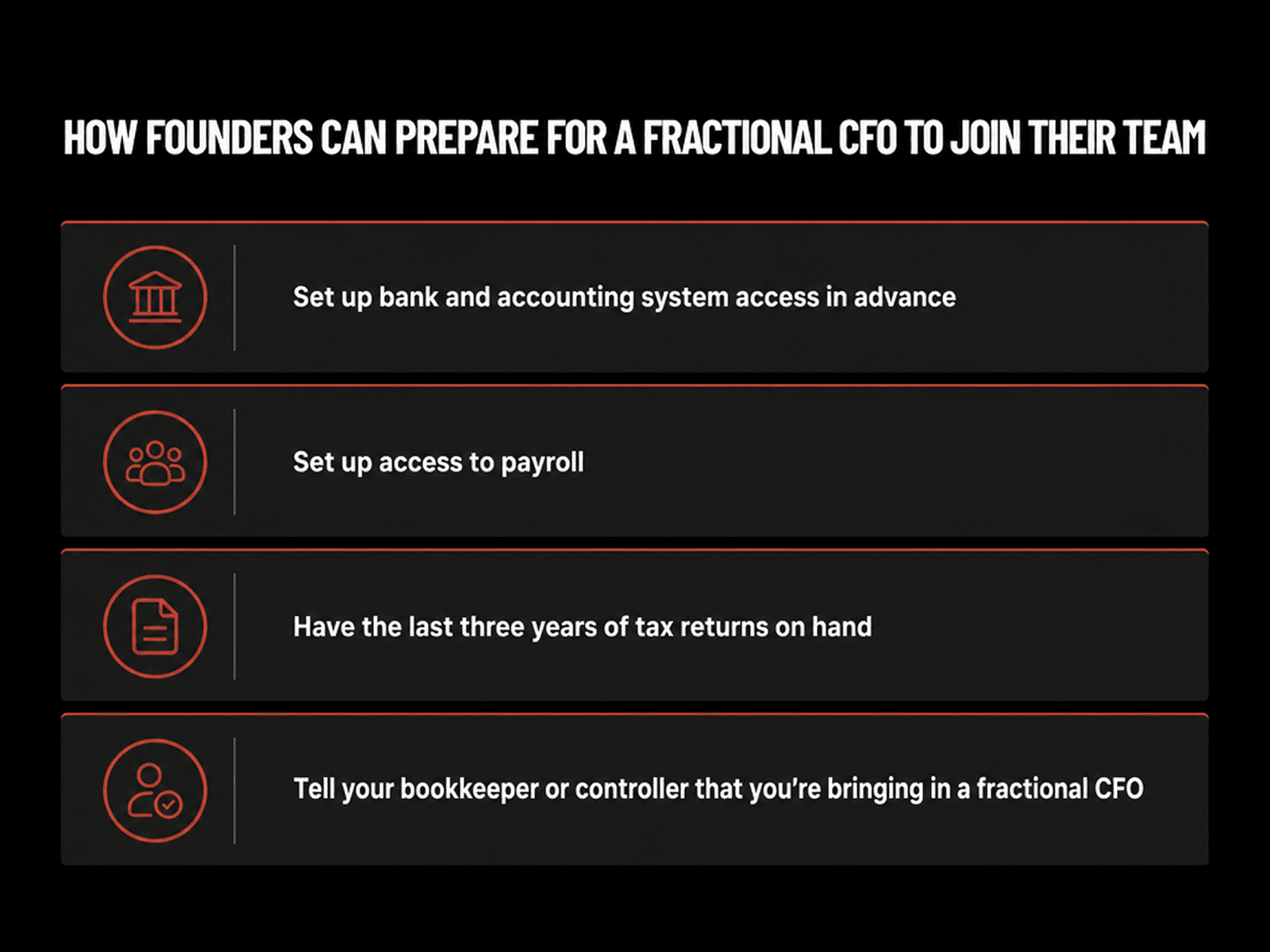
What founders should prepare before day one
The diagnostic phase moves faster when a few things are ready before the engagement starts.
- Set up bank and accounting system access in advance
- Set up access to payroll
- Have the last three years of tax returns on hand
- Tell your bookkeeper or controller that you’re bringing in a fractional CFO
That last one is particularly important, since that person usually holds institutional knowledge that doesn’t live in any spreadsheet: why a particular vendor gets paid on unusual terms or why a specific account has looked strange since a system migration two years ago.
Bringing them into the process early, rather than treating the engagement as something happening around them, tends to shorten the diagnostic phase and reduce friction later.
Finally, founders benefit from setting internal expectations. If other leaders in the business are used to informal, verbal updates on financial matters, a shift toward structured monthly reporting can feel bureaucratic at first. A short internal note explaining what’s changing and why tends to smooth that transition considerably.
Mistakes founders make during onboarding
A few patterns show up often enough to be named directly.
Treating the engagement like bookkeeping
If the relationship remains limited to categorizing transactions and producing statements, the strategic value of fractional CFO services will never materialize. The bookkeeping should already exist as a foundation; this role starts where that foundation ends.
Withholding financial access
Some founders are cautious about sharing full visibility into bank accounts, payroll, or existing tax filings early on. That caution is understandable given how personal financial information can feel, but it slows the diagnostic phase and delays everything downstream, including any tax planning that depends on an accurate starting picture.
Expecting a strategy before diagnosis
Founders sometimes want the month-three conversation in week two. An advisor who skips the audit to deliver strategic recommendations early is often working from assumptions rather than data, which tends to produce advice that doesn’t survive contact with the actual numbers.
Treating taxes as a once-a-year event
A common finding in month one is that tax decisions have historically been made reactively, right before a filing deadline, rather than throughout the year as income and expenses shift. Rebuilding that cadence into ongoing tax planning takes deliberate effort.
Data and research insights
Financial visibility problems are common enough to be well-documented. According to the Bureau of Labor Statistics’ Business Employment Dynamics program, business survival declines sharply in the early years, with roughly half of new establishments no longer operating within five years of opening.
Undercapitalization and poor cash visibility are recurring contributors to that pattern, which is precisely the gap this kind of onboarding process is built to close.
On the staffing side, research from Robert Half and the Financial Executives Research Foundation found that companies with less than $25 million in revenue typically finance functions with a median of only three people on staff.
For founders in that range, bringing on a fractional CFO often represents the first access to senior-level finance expertise the business has had, which explains why the first 90 days can surface issues that went unnoticed for years rather than months.
Signs the engagement is working
Rather than a list of tools, the more useful marker by day 90 is a short set of outcomes. Look for the following:
- A monthly close that happens on a fixed schedule instead of whenever time allows
- A cash forecast that the founder actually checks before making a hiring or spending decision
- Tax planning conversations that happen quarterly
- A founder who can explain, in specific terms, why margin moved in either direction last month, rather than shrugging and pointing to “a slow quarter”
If those things are in place, the foundation is solid enough to build on.
FAQ
Q: How much time does a founder need to commit to during the first 90 days?
Expect more involvement early on, mainly for discovery conversations and access to systems, tapering to periodic check-ins by month three as the advisor builds independent visibility into the business.
Q: Does this role handle tax filing directly?
Most fractional CFOs coordinate closely with a CPA or tax preparer rather than filing returns themselves. Their role centers on proactive planning throughout the year, timing income and expenses, and flagging entity decisions, while the CPA handles compliance and filing.
Q: What if the diagnostic reveals bigger problems than expected?
This is common and not usually a sign of failure. It typically means financial issues went unaddressed for a while, which is often the reason the engagement started in the first place, rather than evidence that anything was done wrong.
Q: Can value show up before day 90?
Yes, often in the form of quick fixes to obvious errors. But the deeper value, accurate forecasting and informed strategic decisions, depends on the full diagnostic and stabilization work happening first.
Q: How is this different from working with an outsourced bookkeeper?
A bookkeeper records transactions and produces statements. A fractional CFO interprets those numbers, builds forward-looking models, and advises on decisions like pricing, hiring, and tax strategy.
Work with STRIV CPAs
The first 90 days are about building the financial foundation that enables strategy. Founders who understand that sequence tend to get far more out of fractional CFO services than those looking for instant answers, and they tend to trust the recommendations that follow because they watched the groundwork get laid first.
STRIV CPAs has the knowledge and experience you need to truly help your growing business. Schedule your consultation today.